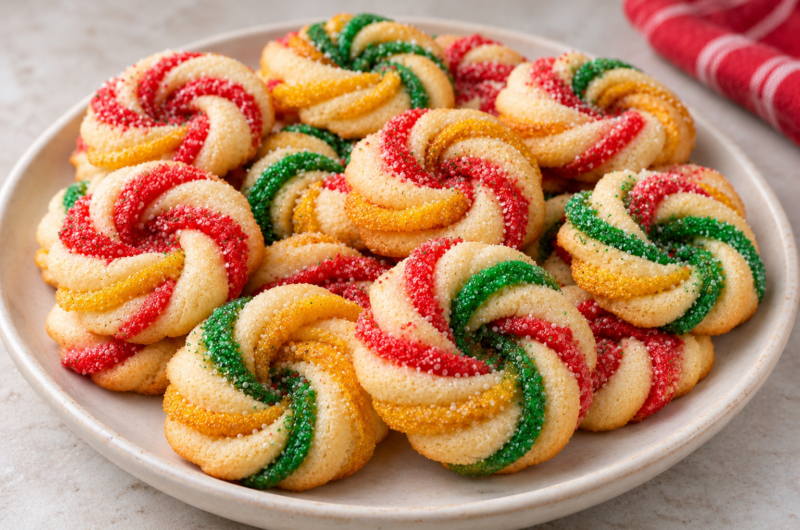
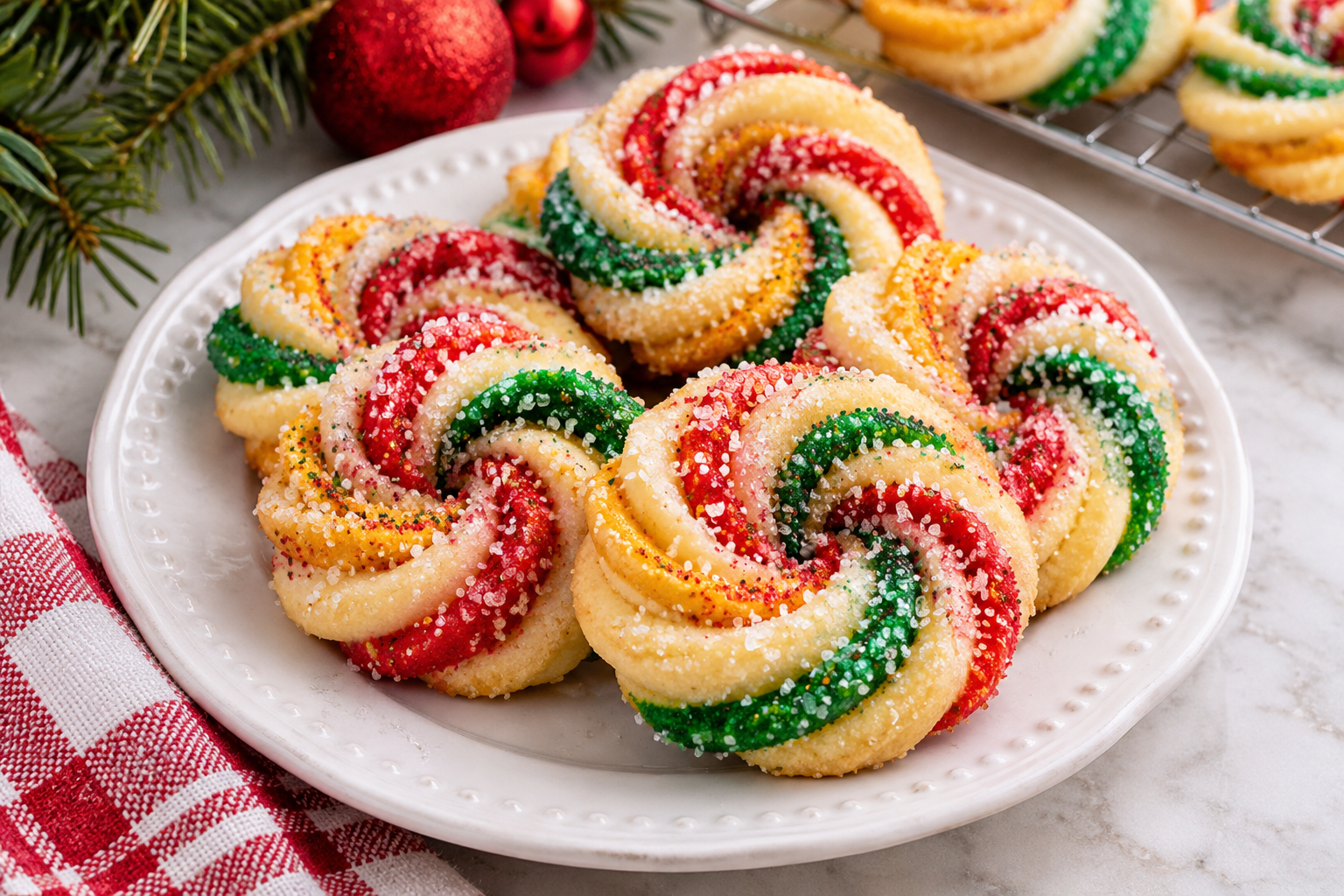
Finished twisted Christmas cookies with red, green, gold and vanilla swirls on a serving plate.
These twisted Christmas cookies turn one buttery vanilla dough into little four-color spirals, with lightly crisp edges and tender middles. Red, green and gold strands wind around plain dough, while a scattering of sugar gives the tops a delicate crunch. Jump to recipe
Why the twisting technique works
Shaping four narrow ropes together creates an unmistakable swirl without needing icing or a piping bag. A brief chill firms the butter so the coils stay recognizable as they bake, and stopping when only the edges turn pale gold keeps the centers tender. Handle the dough gently: stretching or overworking the ropes makes the twist less defined.
Ingredients and what they do
- 225 g (1 cup) unsalted butter, softened but not melted — gives a tender, buttery crumb.
- 150 g (3/4 cup) granulated sugar — sweetens and helps the cookie edges crisp.
- 1 large egg, at room temperature — binds the dough so the ropes can be shaped.
- 2 tsp vanilla extract — flavors all four dough colors.
- 330 g (2 3/4 cups, spooned and leveled) all-purpose flour — provides enough structure for a rolled twist.
- 1/2 tsp baking powder — gives just a little lift without puffing away the spiral.
- 1/2 tsp fine salt — balances the sweetness.
- Red, green and yellow or gold gel food coloring, about 2–4 drops of each, adjusted to shade — colors three of the four portions; keep one plain.
- 2 tbsp white sanding sugar — gives sparkle and a light crunch.
- 1 tbsp red sanding sugar, 1 tbsp green sanding sugar and 1 tbsp gold sanding sugar — lightly accent the colored bands.
Use gel colors sparingly so the dough does not become sticky. Liquid coloring may require more drops and can soften the dough. Coarse decorative sugar can replace sanding sugar, but the topping will be chunkier. All-purpose wheat flour and butter are central to the stated texture; replacing either requires a different formulation.
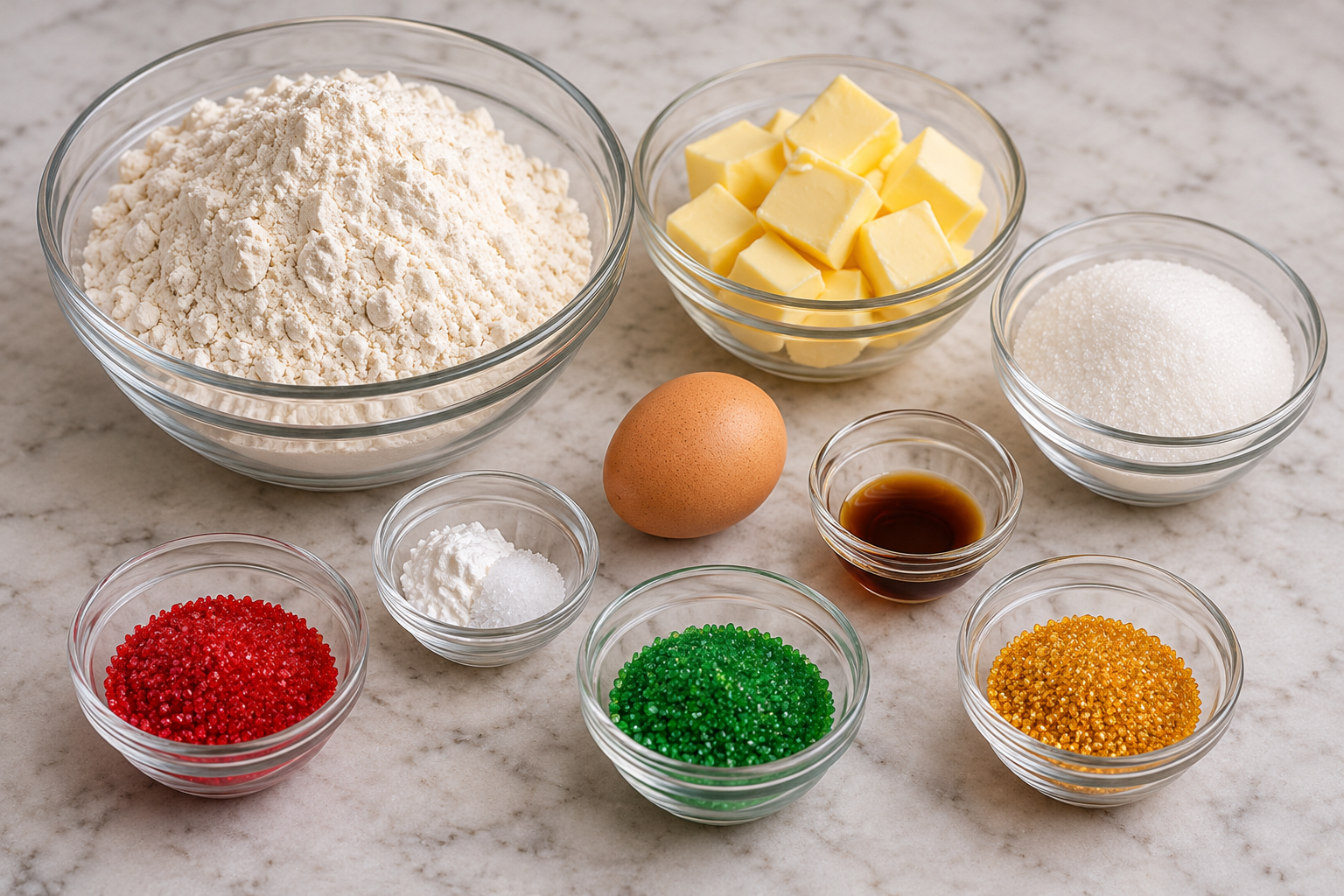
Butter, flour, sugar, egg, vanilla and small bowls of colored decorations set out before mixing.
Equipment
- Stand mixer or hand mixer and a large bowl
- Medium bowl, whisk, spatula, and kitchen scale
- Bench scraper or sharp knife
- Two large rimmed baking sheets (roughly 33 × 46 cm / 13 × 18 inches)
- Parchment paper, refrigerator space, and wire cooling rack
How to make twisted Christmas cookies
- Cream and combine (7 minutes). Beat 225 g softened butter with 150 g sugar on medium speed for 2–3 minutes, until slightly paler and fluffy. Beat in the egg and vanilla just until smooth.
- Add the dry ingredients (5 minutes). Whisk the flour, baking powder and salt in a separate bowl. Add to the butter mixture on low speed, stopping as soon as no dry flour remains. The dough should feel soft and pliable, not wet.
- Divide and tint (8 minutes). Split the dough into four equal pieces, approximately 185–190 g each. Leave one vanilla-colored; knead small amounts of red, green and gold gel coloring into the others. Avoid overmixing.
- Roll, twist and coil (20 minutes). Divide each colored portion into 24 small pieces. For each cookie, roll one piece of each color into a rope about 10 cm / 4 inches long and about 6 mm / 1/4 inch thick. Lay the four ropes next to one another, press one end together, twist the bundle two or three times, then coil into a flat spiral about 5 cm / 2 inches across. Tuck the ends under. Arrange 12 coils on each parchment-lined sheet with at least 5 cm / 2 inches between them. Combine the four sugars in a shallow dish and distribute evenly over the 24 cookies, pressing lightly so the grains adhere.
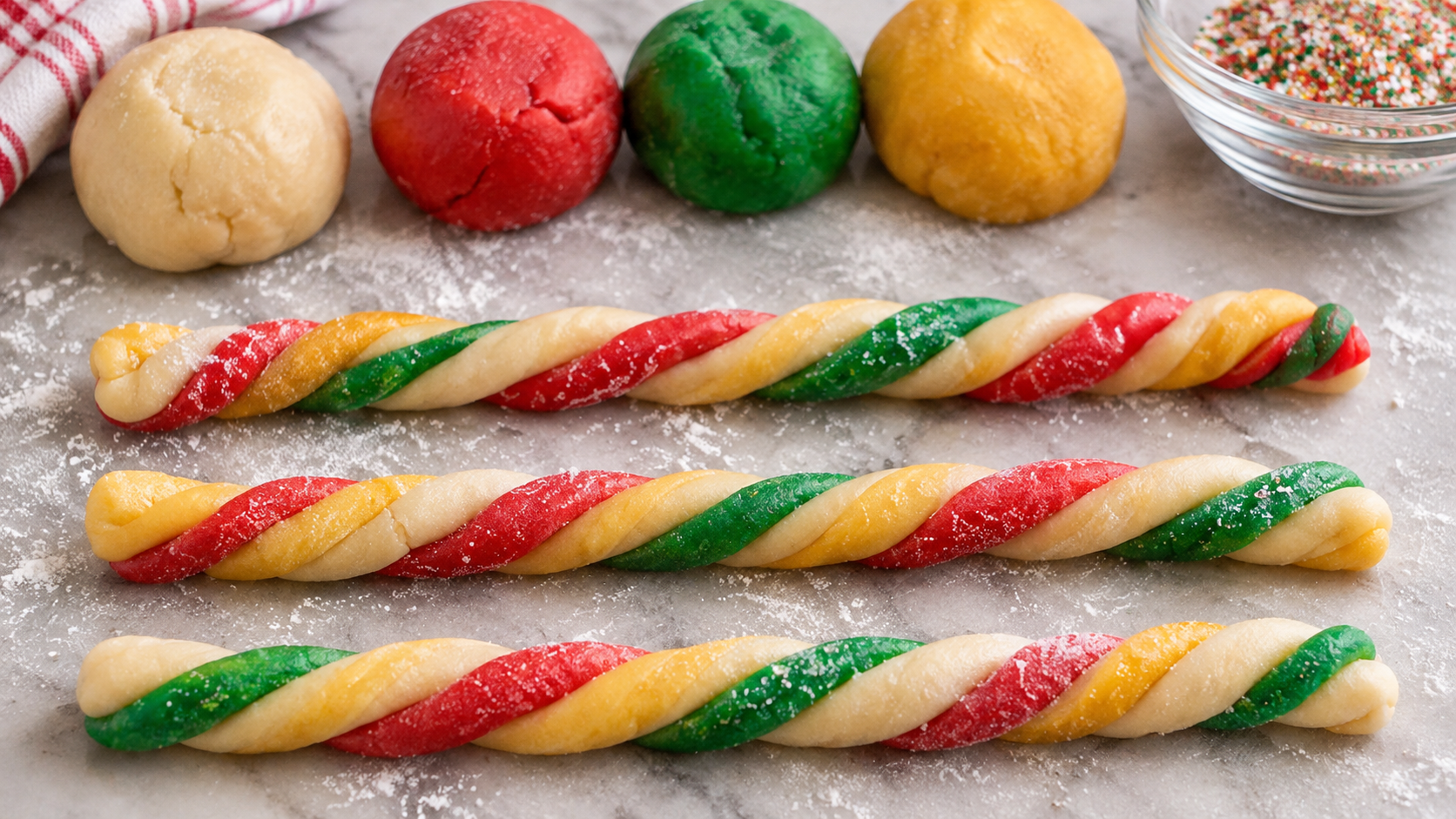
Four colored strands twisted into ropes before they are coiled into individual cookies.
- Chill (30 minutes). Refrigerate the shaped cookies on their trays for 30 minutes, until the butter firms and the coils no longer feel tacky. During the last 10 minutes of the chill, heat the oven to 175°C / 350°F (conventional oven).
- Bake (14 minutes). Place the sheets on upper-middle and lower-middle racks. Bake for 12–14 minutes, exchanging rack positions and rotating front-to-back at the halfway point. The cookies are ready when the outer edges look set and just faintly golden and the tops are matte; do not wait for the colorful tops to brown. If the oven cannot accommodate both trays with airflow, bake in two batches, adding 12–14 minutes to the total elapsed time.
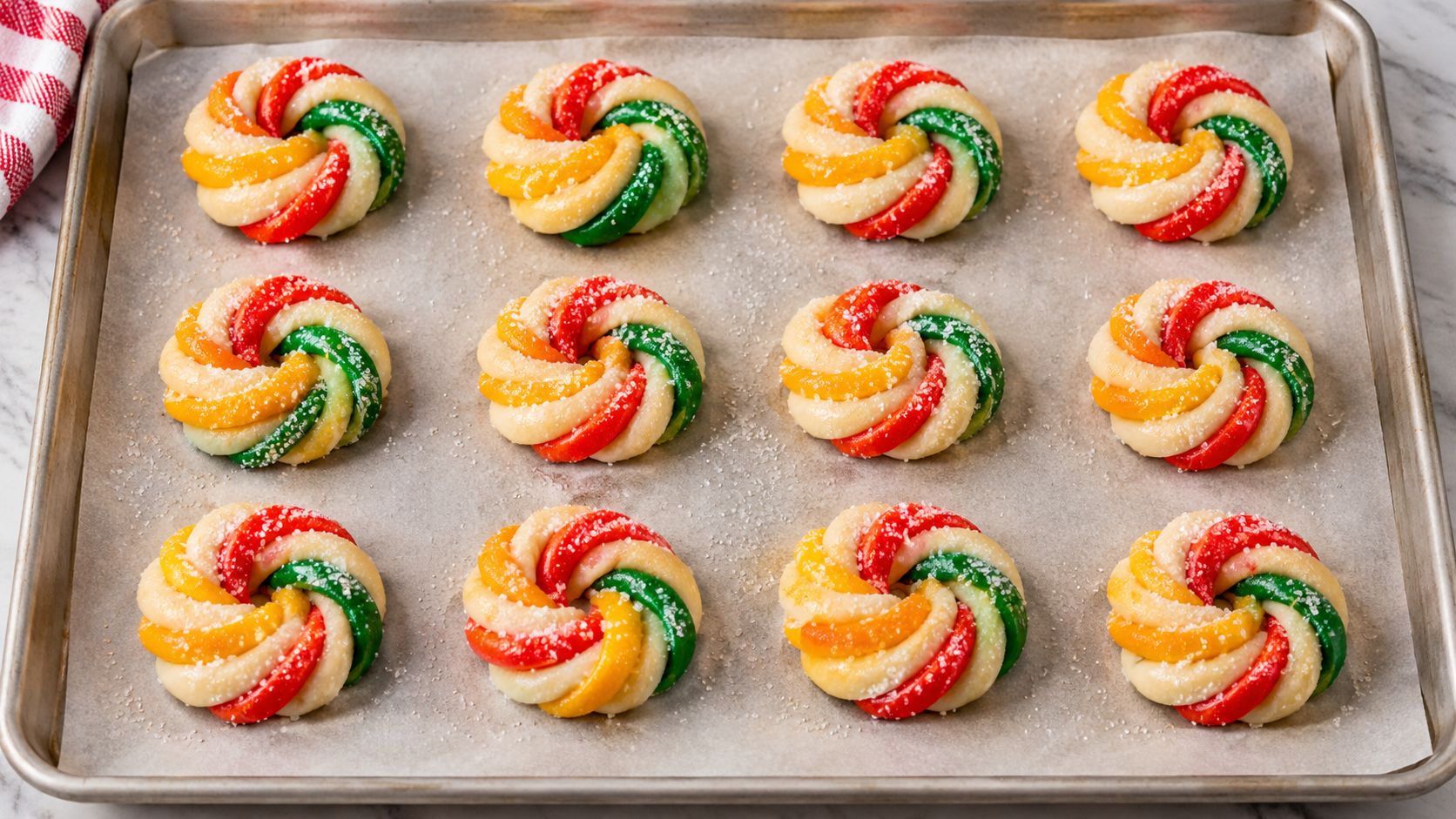
Twisted cookie spirals evenly spaced on a parchment-lined baking sheet at the baking stage.
- Cool (15 minutes). Leave the cookies on their trays for 5 minutes so they set, then transfer with a thin spatula to a rack for about 10 more minutes, until cool enough to handle without breaking.
Troubleshooting and sensible substitutions
- Ropes break: The dough may be too cold or dry. Let it stand 3–5 minutes, then press cracks together without adding liquid.
- Coils spread: Chill the shaped cookies for the full 30 minutes and check that the butter was soft, not melted, at mixing.
- Colors smear: Roll on a clean, dry surface, wipe hands between colors, and stop twisting once the strands form a visible spiral.
- Bottoms brown too fast: Use light-colored sheets and parchment, and move the pan up one rack next time. Dark pans transfer heat differently.
- Prefer fewer colors? Use two plain strands with one red and one green strand; the same dough and timing still apply. Food dyes and decorations vary by brand, so check labels for allergens.
Serving suggestions
Offer the cooled cookies on a simple white platter so the colors stand out, or pack them in a single layer with parchment between layers for a holiday cookie exchange. They work particularly well alongside black tea, coffee or hot chocolate; no frosting is needed.
Storage and freezing
Let the cookies cool completely before sealing them. For best texture, keep them in an airtight container at cool room temperature for about 4–5 days, separated by parchment if stacked. Freeze fully cooled baked cookies in an airtight freezer-safe container for up to 2 months for best quality; thaw covered at room temperature to avoid condensation on the sugar. There is no need to reheat, but 2–3 minutes in a 150°C / 300°F oven can freshen a softened cookie; cool briefly before eating. These are quality guidelines, not validated shelf-life or food-safety guarantees.
Frequently asked questions
Can I make the dough the day before?
Yes. Wrap the four portions separately and refrigerate for up to 24 hours. Allow them to soften just enough to roll; this is optional make-ahead time and is not included in the 99-minute same-day total.
Why is the spiral easier to see before baking?
The ropes relax a little in the oven. Keeping them a consistent thickness and chilling the formed coils gives the colors a better chance of staying separate.
Can I use regular food coloring?
You can, but liquid color adds moisture. Use the smallest amount that gives a visible shade; if the dough turns sticky, chill briefly rather than adding a lot more flour.
Should the cookies be brown on top?
No. The top should look dry and matte, with just a light golden edge. The colors will stay brighter if the tops do not darken.
Can I freeze unbaked coils?
Yes. Freeze the shaped coils on a lined tray until firm, then seal in a freezer-safe container for up to 1 month for best quality. Bake from frozen at the same temperature, allowing about 2–3 additional minutes and checking the edges.
A festive finish
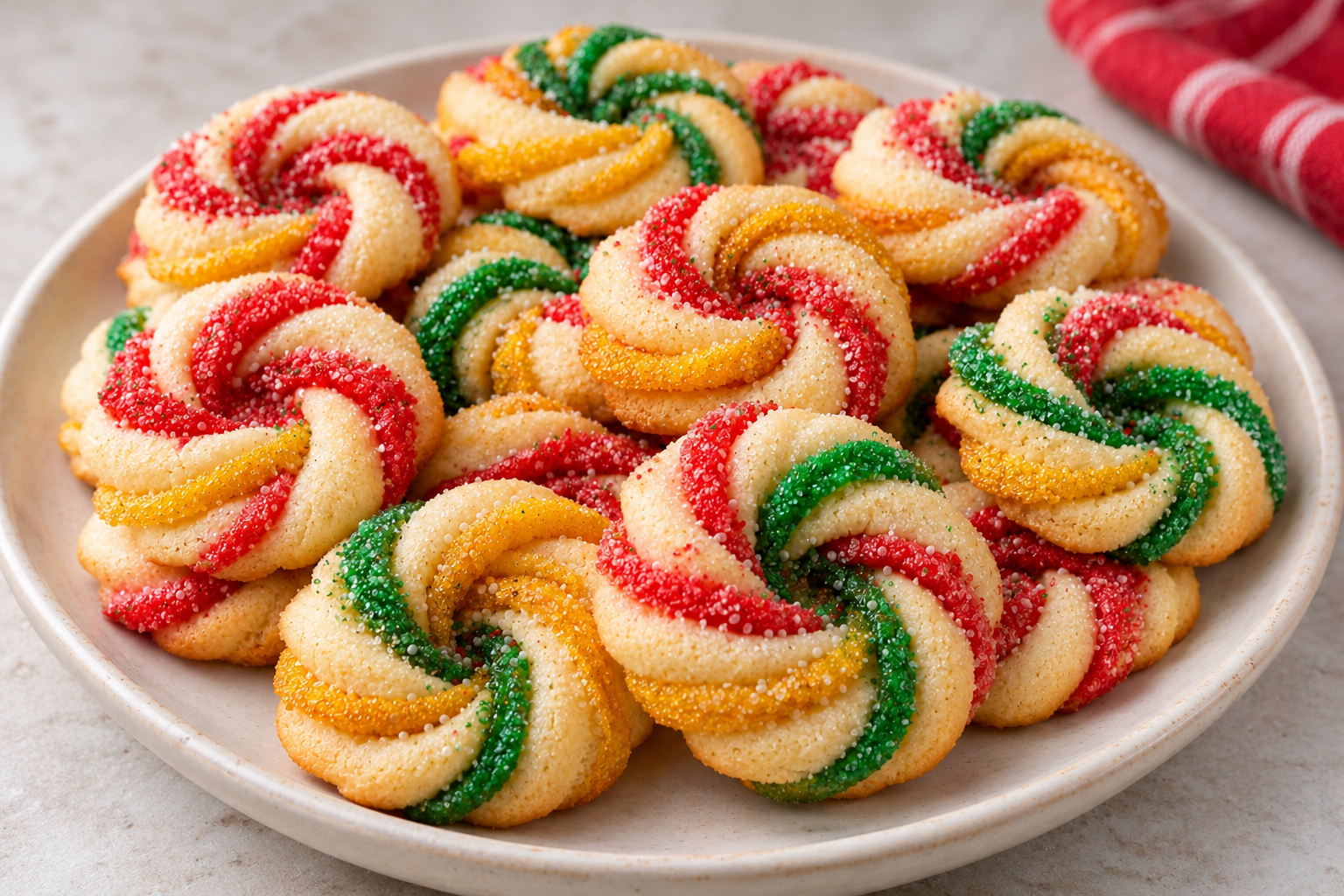
The charm is in the uneven little swirls: some show more green, others more red or gold. Set them out once fully cool so the sugar stays crisp and the delicate coils hold together.
A separate serving arrangement of baked, sugar-coated red, green, gold and vanilla spiral cookies.
Twisted Christmas Cookies Recipe
These twisted Christmas cookies turn one buttery vanilla dough into little four-color spirals, with lightly crisp edges and tender middles. Red, green and gold strands wind around plain dough, while a
24 cookies (24 small, approximately 5 cm / 2-inch spirals)
40
minutes14
minutes1
hour39
minutesIngredients
225 g (1 cup) unsalted butter, softened, not melted
150 g (3/4 cup) granulated sugar
1 large egg, room temperature
2 tsp vanilla extract
330 g (2 3/4 cups, spooned and leveled) all-purpose flour
1/2 tsp baking powder
1/2 tsp fine salt
Red gel food coloring, about 2–4 drops
Green gel food coloring, about 2–4 drops
Yellow/gold gel food coloring, about 2–4 drops
2 tbsp white sanding sugar
1 tbsp red sanding sugar
1 tbsp green sanding sugar
1 tbsp gold sanding sugar
Directions
- Cream butter and granulated sugar 2–3 minutes until pale and fluffy; beat in egg and vanilla just until combined (7 minutes total).
- Whisk flour, baking powder and salt. Mix into the wet ingredients on low just until a soft dough forms (5 minutes).
- Divide into 4 equal portions, about 185–190 g each. Leave one plain; tint the other three red, green and gold with gel coloring (8 minutes).
- Divide each portion into 24 pieces. Roll 1 piece of each color into 10 cm / 4-inch ropes; line up, pinch one end, twist 2–3 times and coil to a roughly 5 cm / 2-inch spiral. Tuck ends under. Arrange 12 per lined sheet, spaced 5 cm / 2 inches apart. Mix the 4 sanding sugars and distribute over the cookies, pressing lightly (20 minutes).
- Chill the shaped cookies on their sheets for 30 minutes. Preheat oven to 175°C / 350°F during the final 10 minutes.
- Bake both trays for 12–14 minutes, rotating and exchanging rack positions halfway, until edges are set and faintly golden and tops look matte (14 minutes maximum). If baking sequentially, add another 12–14 minutes to elapsed time.
- Cool on baking sheets 5 minutes, then transfer to wire racks for about 10 minutes more (15 minutes total).
Notes
- Equipment: Stand or hand mixer; large and medium mixing bowls; Whisk, spatula, kitchen scale and bench scraper or knife; 2 parchment-lined 33 × 46 cm / 13 × 18-inch baking sheets; Wire rack
- Gel colors keep the dough firmer than liquid colors. Measure flour carefully and do not overmix.
- The stated 99-minute total assumes both sheets bake at once; baking consecutively adds 12–14 minutes.
- Store fully cooled cookies airtight at room temperature for approximately 4–5 days for best quality, or freeze up to 2 months.
- Rest time: 30 minutes
- Cooling time: 15 minutes